On the Ground in Rasuwa: Supporting Communities After the Flood
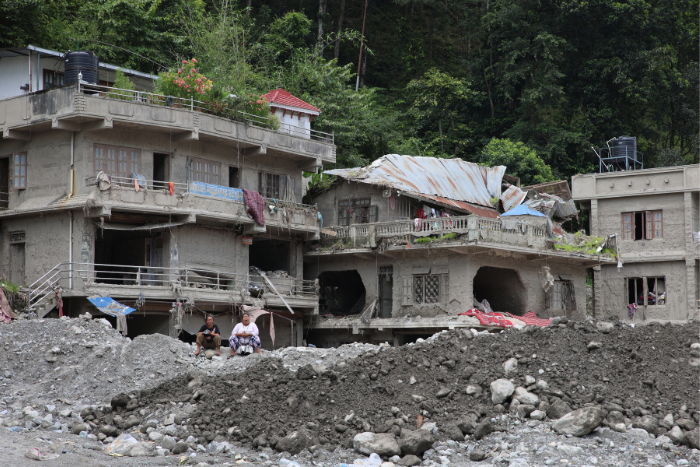
This week, we set out with local partners toward the Kalika and Uttargaya Rural Municipalities in Rasuwa, which were devastated by the August 26 flood. Our partners on the ground had identified both municipalities as being in urgent need of support. In the days before we left, we stayed in close contact with local leaders to understand exactly what their communities needed most.
Reaching the municipalities was, in itself, a difficult journey. What would normally be a three-hour drive along the highway took nearly 14 hours. The highway had been washed away by the flood, so the only route was through the hills on a mud road. Even four-wheel-drive vehicles struggled to navigate some sections, and if they got stuck, the entire convoy had to stop and wait. This kind of damage to the region's infrastructure has made relief work difficult across Rasuwa. With the main highway gone, aid organizations and supplies have all been forced onto the same slow, unreliable mountain roads, delaying assistance to those that can least afford to wait.
Arriving in the communities and seeing the extent of the destruction first-hand made the reason for our journey feel even more immediate. There was hardly a household in the village that had not been touched by loss. Families were still grieving, struggling to come to terms with the sudden deaths of their loved ones. Some families had not yet been able to perform the final rites because their loved ones remained unaccounted for, leaving them caught between grief and the hope that they might still return. As we carried out our distributions, we came away with a clearer picture of what these communities have lost, and what they will need in the months ahead.
Relief distribution in Kalika
In Kalika, our local partner FWEAN coordinated with the community to identify families most in need of immediate assistance. We provided 150 families with a cooking gas cylinder (which have been hard to come by due to a global shortage), a portable gas stove, lentils and beans, and daily sanitation items like soap and detergent, dental hygiene products, and sanitary pads.
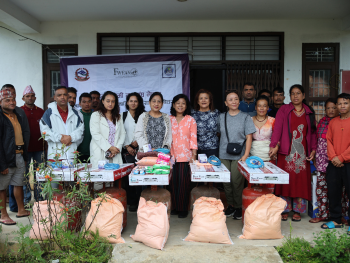
While we were there, we spoke with several of the beneficiaries who shared deeply distressing accounts of losing family members and the challenges they are now facing. According to local representatives, it is estimated that 96 people from the municipality were swept away. Many of those who lost their lives were young people between the ages of 18 and 40 who had travelled towards the China border for work and were the sole income earners in their families. They have not only lost sons, husbands, and fathers, but also the support on which they depended. Many children have lost one or both parents and are now at risk of discontinuing their education because their families no longer have the means to meet basic expenses.
Tej’s story
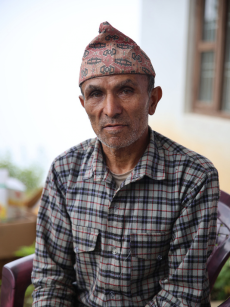
In Kalika, 60-year-old Tej lost his elder son — the family's sole earning member — in the Rasuwa flood. His son, an Armed Police Force (APF) member stationed in Timmure, had visited home just days before and returned to duty only a day before the disaster struck. His phone has been unreachable since, his body not yet located, and the family has been told recovery is unlikely.
The son supported his parents, wife, three-year-old son, and younger brother, whose university studies in Kathmandu he had been funding. That education, along with ongoing medical treatment for his young son's intestinal condition, is now in jeopardy.
Amid this grief, relief materials distributed through AHF-FWEAN gave the family essential household support, easing pressure during a severe cooking gas shortage and a time of financial uncertainty, and allowing them a measure of dignity and stability as they grieve and begin to piece their lives back together.
Relief distribution in Uttargaya
Following our visit in Kalika, we drove to Uttargaya to deliver more supplies. Together with our partner, Lumanti, we distributed relief packages to approximately 100 individuals staying at two holding centers. The packages included bedding, mosquito nets, personal hygiene and cleaning supplies, undergarments, and other essential items. The support was appreciated by both the recipients and local government representatives, particularly as many organizations had already provided food assistance. The non-food items that we were able to provide filled the remaining gaps.
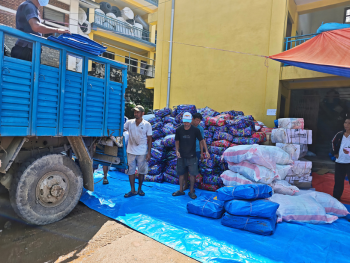
Both holding centers in the community were initially established in schools. As schools have started to reopen, one center has been relocated to a local enterprise building. At the other, classes are conducted during the day while displaced families sleep in the same classrooms at night. Basic facilities remain inadequate, with toilets, showers and cooking areas shared among large numbers of people — leaving limited space and privacy, particularly for pregnant and postpartum women.
In both Kalika and Uttargaya, local leadership identified safe and adequate shelter as the most urgent need for families who have lost their homes. Once more detailed information about the damaged homes is collected and further guidance is received from the central government, municipalities can proceed with arrangements for temporary shelter and, eventually, permanent housing with support from I/NGOs.
Looking toward the future
The field visit gave us a clearer picture of the flood's full scale and its impact on communities in Kalika and Uttargaya. The damage goes far beyond physical infrastructure: many families have lost loved ones, homes, and their primary sources of income, leaving them to face both immediate hardship and deep uncertainty about what lies ahead. Our relief distribution offered timely support to families struggling to meet even their most basic needs — but the visit also deepened our understanding of what these families will need in the weeks and months to come as they begin to rebuild.
The extent of the destruction to infrastructure remains a major constraint to recovery. Damaged roads continue to affect the movement of people, relief materials, medical services, and essential supplies. The destruction of businesses and disruption of border trade have also significantly reduced livelihood opportunities. At the same time, many families remain displaced, either staying with relatives or in temporary and overcrowded holding centers. As schools that have been used as holding centers begin to reopen, the need to identify alternative and more appropriate accommodation is becoming increasingly urgent.
The loss of primary income earners is another major concern. Many families have lost the individuals on whom they depended financially, including young adults who were working in the border areas. The situation is also particularly challenging for pregnant and postpartum women and families with young children. These groups may require more targeted support as communities move beyond the immediate emergency phase.
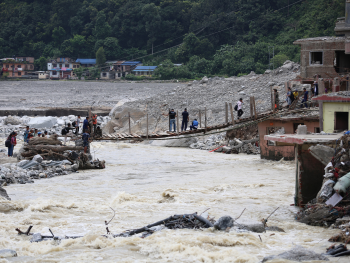
Amid the scale of destruction, there were also small but encouraging signs of recovery. During our visit, we passed through Betrawati, once a vibrant business hub that had been almost completely washed away by the flood. At the time of our visit, the Nepal Army had just completed a temporary pedestrian bridge, restoring a basic connection for people in the area. While modest in itself, this was a visible reminder that reconstruction and recovery are already beginning, even as communities continue to deal with profound loss.
For us, the journey to Rasuwa was difficult, but what stayed with us most was not the difficult road. It was the people we met along the way — the families still waiting for news of their loved ones, the children who have lost their parents, and the community leaders trying to support them while dealing with their own grief. The visit reinforced how important timely and continued support is as the community begins the long process of rebuilding.
Charu Pradhan is based in Kathmandu, Nepal, and has been working with AHF for more than 25 years. All photos are courtesy of Rabi Raj Shrestha.